One eyelid sitting noticeably lower than the other is one of the most common concerns we hear at our Fullerton office. And for most patients who come in with this specific complaint, the cause is not extra skin. It is not something that sleep, eye drops, or any topical product will address.
It is ptosis. And more specifically, unilateral ptosis, where one eyelid droops due to a weakening of the muscle responsible for lifting it, while the other eyelid remains in a completely normal position.
This is the story of a patient who had exactly that. One eye. One precise repair. And a result that speaks for itself.
What He Came In With
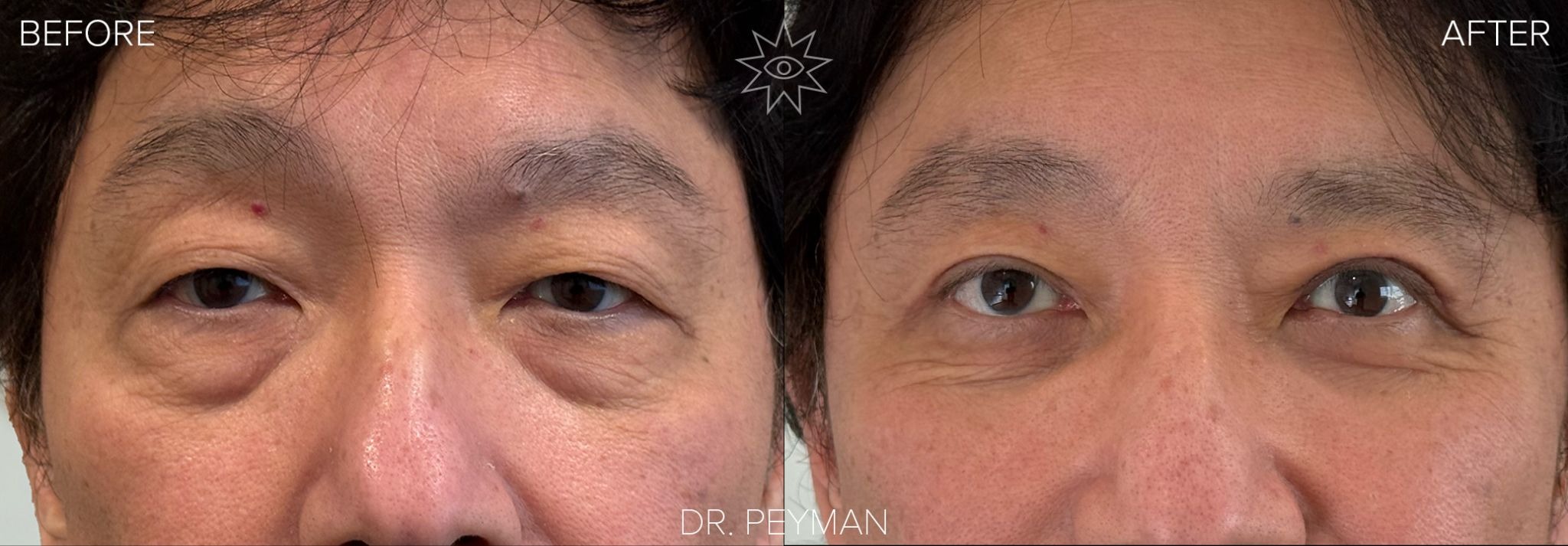
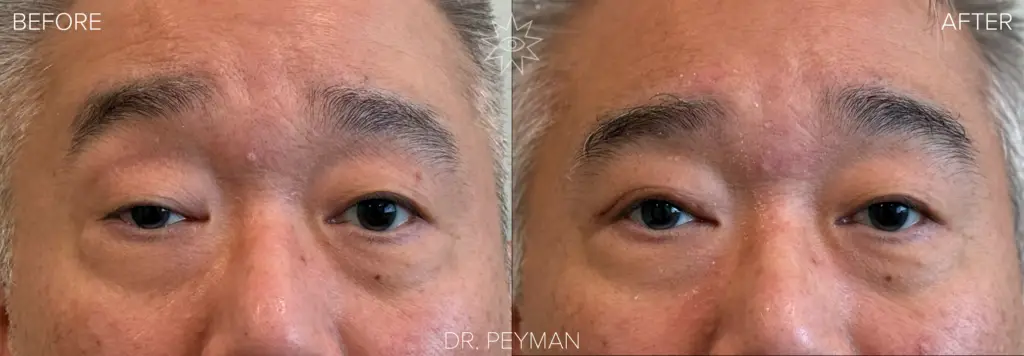
Looking at his before photo, the asymmetry is immediately apparent.
His right upper eyelid sits significantly lower than his left. It is not a subtle difference. The drooping lid partially covers the iris on that side, creating an imbalance between the two eyes that changes his entire expression. His left eye is open and alert. His right eye, despite being completely healthy, looks partially closed, heavy, and tired by comparison.
He had been living with this for some time, the way many ptosis patients do. Not fully registering it in his own daily reflection until it appeared in a photograph or someone mentioned it. He came in assuming the problem was excess skin on that eyelid and that the solution would be removing it.
The evaluation told a different story.
The Diagnosis: Ptosis, Not Excess Skin
This distinction matters more than most patients realize, and it is one of the most important things Dr. Peyman assesses at every consultation involving a drooping eyelid.
In a patient with excess skin, the eyelid platform itself sits at a normal height. The issue is that redundant skin folds down over the crease and partially covers the eye. The fix is a blepharoplasty: carefully removing or reshaping that skin.
In a patient with ptosis, the eyelid platform itself sits too low. The levator muscle, the muscle responsible for lifting the upper lid, has weakened, or its attachment to the lid has stretched over time. The lid margin is in the wrong position. Removing skin would improve the hooding appearance slightly but would leave the eyelid sitting at the same incorrect height. The real fix is a ptosis repair: tightening or reattaching the levator muscle so the lid can rise to where it belongs.
For this patient, the drooping right eyelid was ptosis. The left eyelid was functioning normally. No skin removal was needed on either side. The entire goal was one precise repair of the levator muscle on the right side to bring it into symmetry with the left.
That is exactly what Dr. Peyman performed. A unilateral ptosis repair. One eye. No blepharoplasty. No lower eyelid work.
Why Getting the Diagnosis Right Changes Everything
Performing a blepharoplasty on a patient with true ptosis is one of the most common reasons patients end up seeking revision surgery. The skin is removed, the hooding improves somewhat, but the eyelid still sits too low because the underlying muscle problem was never addressed. The patient still looks asymmetric. The result still feels incomplete.
Conversely, performing only a ptosis repair on a patient who primarily has significant excess skin may leave residual hooding that was never cleared.
When a patient has both conditions, which does happen, Dr. Peyman performs a combined ptosis repair and upper blepharoplasty in a single procedure. But for this patient, the anatomy was clear: one eyelid with true levator weakness, one eyelid functioning normally, and no significant skin issue requiring removal on either side.
The right diagnosis leads to the right procedure. And the right procedure leads to the result you see in his after photo.
The Procedure: Unilateral Ptosis Repair Under Local Anesthesia
The procedure was performed right here at our Fullerton office, under local anesthesia. No hospital. No general anesthesia. No overnight stay.
During a ptosis repair, Dr. Peyman works through a small incision placed within the natural upper eyelid crease. The levator aponeurosis, the tendon-like tissue connecting the levator muscle to the eyelid, is identified, tightened, and secured in its corrected position. The amount of adjustment is precisely planned based on measurements taken during the pre-operative evaluation.
One of the things that makes ptosis repair particularly demanding as a procedure is that the eyelid height needs to be checked with the patient awake. Having the patient awake throughout allows Dr. Peyman to make real-time intraoperative adjustments and confirm symmetry before completing the repair.
For this patient, having only one side repaired made that symmetry check even more straightforward. The left eyelid served as a direct, real-time reference point throughout the entire procedure.
The Result: Symmetry Restored, Nothing Overdone
Looking at his after photo, the transformation is meaningful and completely natural.
Both upper eyelids now sit at the same level. The right eye, which had been partially obscured by the drooping lid, is now open, alert, and balanced with the left. His entire expression has shifted. He looks present, engaged, and rested in a way that the asymmetry had been quietly preventing for years.
What is equally important is what did not change. His lower lids were not touched. No skin was removed from either upper lid. His overall facial character is exactly the same. The only difference is that both eyelids are now symmetric, and that single correction carries an impact that is immediately clear when you compare the two photos side by side. His brow on the right side is now in a more relaxed position because he doesn’t feel like lifting it anymore now that the eyelid position is improved.
This is what precision surgery looks like. Not doing more than is needed. Identifying the exact problem, correcting exactly that, and leaving everything else alone.
Unilateral vs. Bilateral Ptosis: What Is the Difference?
Ptosis can affect one eye or both.
Unilateral ptosis, as in this patient’s case, affects only one eyelid. The asymmetry between the two sides is typically what brings patients in, because one eye simply does not match the other. The goal of repair is to bring the affected side up to meet the healthy side.
Bilateral ptosis affects both upper eyelids. Both lids sit too low, creating a heavy, fatigued appearance across the entire eye area. Patients with bilateral ptosis sometimes do not notice the problem as immediately because there is no obvious asymmetry to compare, just a gradual heaviness that worsens over time.
Both conditions involve the same underlying mechanism, a weakening of the levator muscle or its attachment, and both are treated with ptosis repair rather than blepharoplasty. You can read about a severe bilateral ptosis case here: I Could Barely Open My Eyes: A Severe Bilateral Ptosis Repair Transformation in Orange County.
Signs You May Have Unilateral Ptosis
If any of the following sounds familiar, a consultation with Dr. Peyman may confirm whether what you are living with is unilateral ptosis:
- One upper eyelid consistently sits lower than the other in photos and in the mirror
- One eye looks smaller, more closed, or more tired than the other regardless of how rested you feel
- You find yourself raising your brow on the affected side to compensate
- People occasionally ask if you are tired or if something seems off with one eye
- The asymmetry has been present for years and has gradually become more noticeable
- A doctor or eye care professional has mentioned that your eyelid may be drooping
The only reliable way to confirm whether you have ptosis, excess skin, or both is a thorough examination by a fellowship-trained oculoplastic surgeon. The distinction matters enormously, and getting it right from the beginning is the most important step toward a result like the one you see here.
FAQ: Unilateral Ptosis Repair
What is unilateral ptosis?
Unilateral ptosis is a condition where one upper eyelid droops lower than the other due to a weakening of the levator muscle or its attachment to the eyelid. Unlike excess skin, which sits on top of a normally positioned lid, ptosis means the lid margin itself is in the wrong position. It can be present from birth or develop gradually over time.
Is unilateral ptosis the same as a droopy eyelid?
Not exactly. Age-related changes most commonly involve excess skin drooping over the crease, which is treated with blepharoplasty. Ptosis is specifically a weakening of the levator muscle that causes the lid margin to sit too low. Both can look similar from the outside, which is exactly why a proper examination is essential before any treatment is planned.
Can unilateral ptosis get worse over time?
Yes. Acquired ptosis typically progresses gradually as the levator aponeurosis continues to stretch. Many patients notice the affected eye sitting a little lower each year. Early evaluation is always better than waiting until the asymmetry becomes more severe.
Do I need surgery on both eyes if only one is drooping?
Only the affected eyelid needs to be repaired. The goal is to bring the drooping lid up to match the healthy side. This patient is a clear example of that. One side repaired, the other left completely untouched although each case is different.
Will the result look natural?
Yes. The goal of ptosis repair is to restore the eyelid to its correct anatomical position, matching the healthy side as closely as possible. A well-performed unilateral ptosis repair should look completely natural, as if the eyelid was simply always meant to sit there.
Is this procedure done under general anesthesia?
No. Dr. Peyman performs ptosis repair right here in our Fullerton office under local anesthesia. Patients are awake and comfortable throughout, which actually allows for more precise intraoperative adjustments since lid height can be verified with the patient sitting upright during the procedure.
Can ptosis repair be covered by insurance?
When ptosis significantly obstructs vision and meets your insurance carrier’s criteria for medical necessity, the repair can be covered. Dr. Peyman performs all necessary documentation and testing at our Fullerton office to determine whether your case qualifies.
How long is recovery from unilateral ptosis repair?
Most patients feel comfortable returning to light daily activities within one to two weeks. Swelling and bruising are typically mild and resolve within two to three weeks. Final results are fully visible by two to three months.
How do I know if I have ptosis or just excess skin?
The only reliable way to know is a thorough examination by a fellowship-trained oculoplastic surgeon. During your consultation, Dr. Peyman will carefully measure your eyelid position and levator function to determine exactly what is causing the drooping and what the right approach is for your specific anatomy.
How do I get started?
Call our Fullerton office at 714-449-1940 to schedule your consultation with Dr. Peyman.
Ptosis Repair in Fullerton and Orange County
Dr. Jason Sabet-Peyman is a fellowship-trained oculofacial plastic surgeon based in Fullerton, California, specializing exclusively in eyelid and periocular surgery. He performs unilateral and bilateral ptosis repair, combined ptosis repair and blepharoplasty, upper and lower blepharoplasty, and laser resurfacing for patients throughout Orange County, including Fullerton, Anaheim, Brea, Yorba Linda, Placentia, Orange, Newport Beach, Irvine, and Huntington Beach.
If one of your eyelids has been drooping and you have been wondering whether anything can be done about it, this patient’s story is the most direct answer we can offer.
Call our Fullerton office at 714-449-1940 to schedule your consultation.
Dr. Jason Sabet-Peyman is a board-certified ophthalmologist and fellowship-trained oculoplastic specialist with over 10 years of experience specializing exclusively in plastic and reconstructive surgery of the eyelids and surrounding facial structures. His practice is located in Fullerton, CA and serves patients throughout Orange County.