
One of the most common things patients say during a consultation is that their eyes look tired. Not that they feel tired. That their eyes look tired, in photos, in the mirror, and to the people around them. Many have already tried sleeping more, changing their routine, or using creams. Nothing changes, because the problem was never fatigue. In many cases, the cause is excess upper eyelid skin and bags under the eyes, and no amount of rest will remove it.
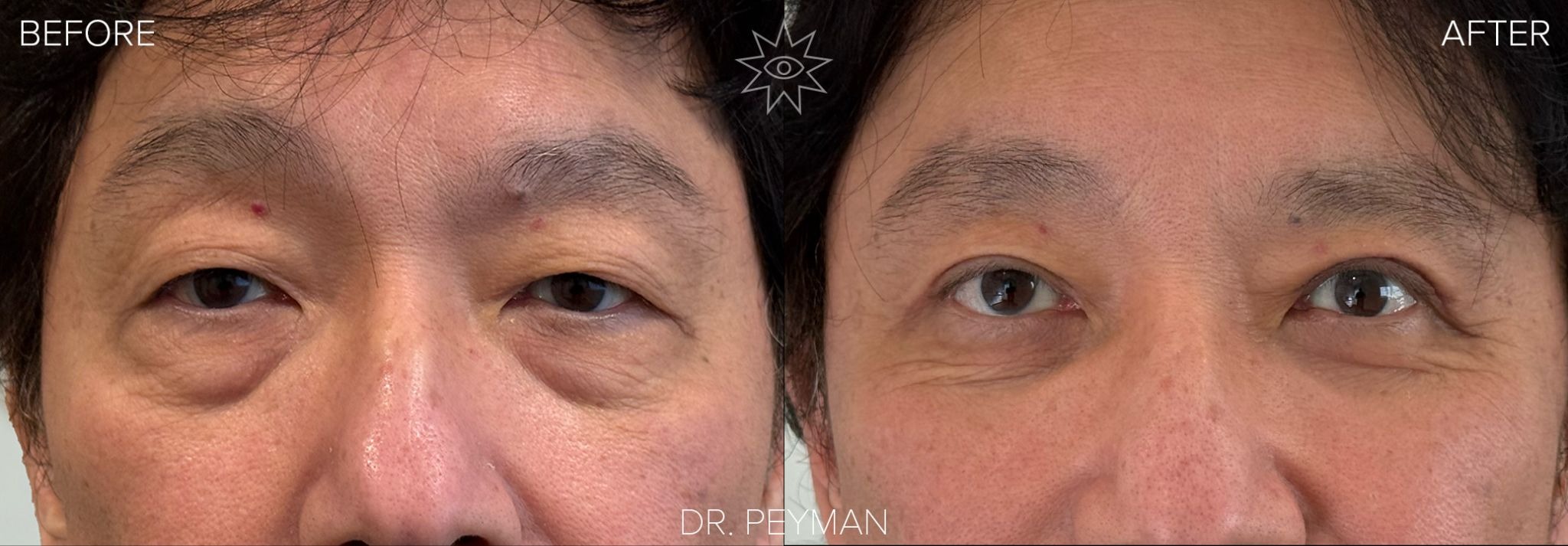
This patient’s before photo shows what that looks like. The skin of his upper eyelids had stretched past his natural crease and was resting on his lash line. His after photo shows the same eyes after an upper and lower eyelid blepharoplasty, with the crease visible again and no skin touching the lashes.
Why does excess eyelid skin make your eyes feel heavy?
Excess eyelid skin makes eyes feel heavy because the skin redundancy is weighing it down.
The skin of the upper eyelid is the thinnest skin on the body, and it loses elasticity earlier than skin elsewhere. As it stretches, it folds past the natural crease and drapes toward the lashes. This is called dermatochalasis, which simply means excess eyelid skin.
Most people unconsciously raise their brows to keep the skin off their lashes, which can tire out the frontalis muscle making the hooding worse in the evening.
How can you tell if it is fatigue or excess skin?
There is a simple check you can do in a mirror. Look straight ahead, place a fingertip at the outer edge of the upper eyelid, and gently lift the fold of skin up and slightly outward. If the heaviness disappears immediately and your eye feels open, the problem is skin. Rest does not produce that result, and neither does caffeine.
Other signs that point to skin rather than fatigue:
- The fold of skin touches or covers your eyelashes when your eyes are open
- Your eyes look the same in photos taken after a full night of sleep as they do after a short one
- You catch yourself raising your eyebrows to see or read more comfortably
- The heaviness is there every day, not only after poor sleep
Fatigue comes and goes with rest. Excess skin does not.
What does the exam look for?
Heavy upper eyelid skin can cover most, if not all, of the upper eyelid platform. This can hide the natural upper eyelid contour. The skin can gently be lifted to assess the natural curve of the upper eyelid margin. This is very helpful in determining whether or not there is an accompanying eyelid droop or ptosis in addition to the skin redundancy.
Sometimes the muscle that opens the eyelid has weakened or stretched, a condition called ptosis, and removing skin alone will not fix it. Learn more about ptosis here. Some patients have both conditions, and the plan has to account for each one.
This patient’s procedure
His examination showed excess upper eyelid skin as the primary finding along with bags under his eyes. An upper and lower eyelid blepharoplasty was performed in our Fullerton office under local anesthesia. Before any incision, the patient is marked in a seated upright natural position. Patients are asked to open and close their eyes a few times during surgery to check symmetry in real time. The upper eyelid skin incision sits within the natural crease, which is why it heals as a fine line that is difficult to find. The lower eyelids were approached through a mucous membrane incision along the lower inner eyelid which heals very well without any scarring on the skin.
His after photo shows the crease where it always was, visible again, with the fold of skin no longer resting on his lashes and the bags have been reduced under his eyes. As with every patient, I called him that evening to check in and he mentioned that he had no pain.
What is recovery like after upper and lower blepharoplasty?
Recovery is usually easier than patients expect. There are no eye covers blocking vision after surgery. Most patients can drive and do desk work the day after the procedure. Sutures come out at about one week, and most visible bruising and swelling resolves over the first two weeks. At the preoperative appointment, we go over written instructions in detail to keep bruising and swelling to a minimum.
Frequently asked questions
Can excess eyelid skin go away on its own?
No. Skin that has lost elasticity does not tighten back to its earlier state. Creams and/or lasers can improve skin quality, but they cannot remove a fold of redundant skin.
Is a heavy-feeling eyelid the same as ptosis?
No. Heaviness from excess skin comes from the fold itself. Ptosis is a problem with the muscle that lifts the eyelid margin. They can look similar, and they can occur together, which is why the examination includes a muscle function test.
Does insurance cover upper blepharoplasty?
When excess skin blocks the upper field of vision and meets strict testing criteria, insurance may cover the procedure. When it does not affect vision, it is considered cosmetic. This is determined at the consultation.
Will there be a visible scar?
The incision is placed within the natural eyelid crease. Once healed, it sits in the fold and is very difficult to see with the eyes open.
How long do results last?
For most patients the improvement is long-lasting. The eyelids continue to age naturally, but they rarely return to the degree of hooding present before surgery.
If the fingertip test sounded familiar
If you lifted the fold and felt your eye open up, the next step is a consultation. We will confirm what is causing the heaviness, whether it is skin, muscle, or both, and what the right plan is for your eyes.
Call 714-449-1940 or book an appointment online. Fresh Eyelids is located in Fullerton and serves patients across Orange County, including Anaheim, Brea, Yorba Linda, Irvine, and Newport Beach. You can also view more patient results in our gallery.