If you have been living with heavy, drooping upper eyelids and assuming that the fix is simply removing some excess skin, you are not alone. It is one of the most common assumptions we hear from patients who walk through our Fullerton office doors for the first time. And while it is completely understandable, it is also one of the most important misconceptions to correct before any treatment begins.
Because for many patients, the real cause of their drooping eyelids has nothing to do with skin at all.
The Patient: When a Routine Visit Changed Everything
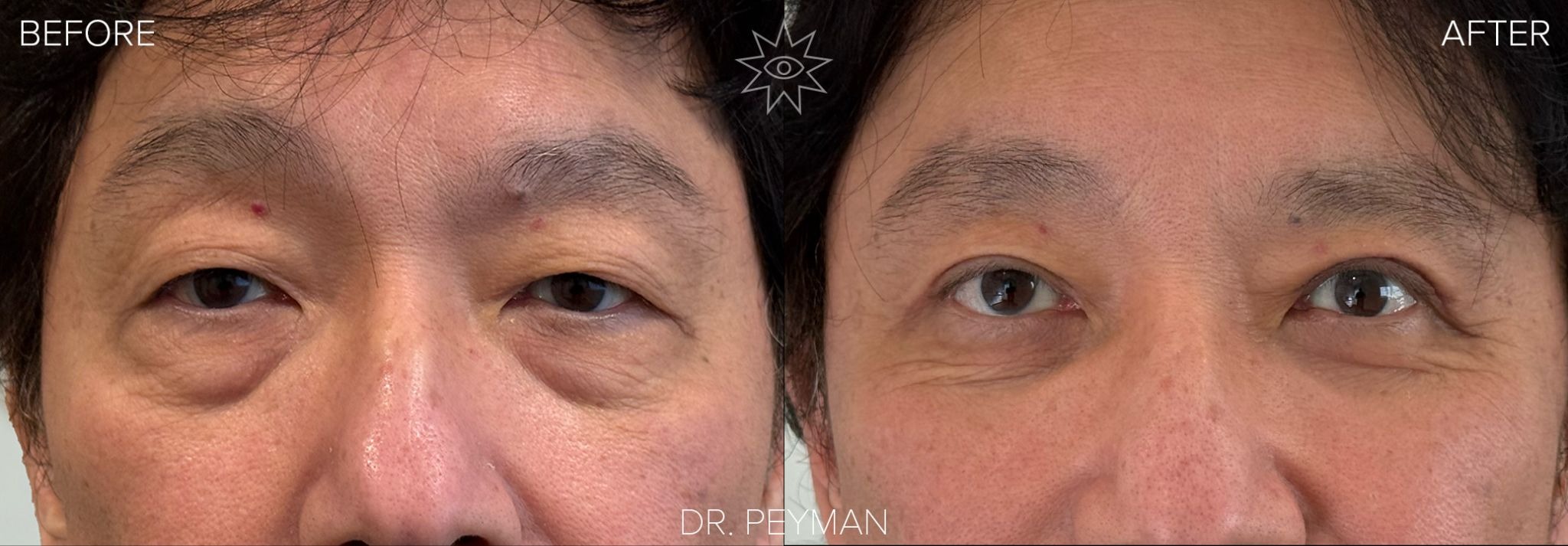
This patient had been living with heavy drooping eyelids for years. It progressed so gradually that he accepted it as his baseline appearance . He looked in the mirror every day and saw his face. He never questioned whether something had changed or whether anything could be different.
It was his doctor who noticed it first.
During a routine visit his physician looked at him and recognized immediately that the drooping over his eyes was not simply a cosmetic concern or a normal part of aging. It was significant enough to warrant a referral to a specialist. He referred this patient directly to Dr. Peyman at our Fullerton office.
That single referral changed everything.
When he came in for his consultation he told us what most patients tell us. He thought he just had some extra skin on his eyelids. He assumed if anything was done it would simply involve removing that skin. He had no idea that what he was actually living with had a specific medical name, a distinct anatomical cause, and a precise surgical solution that had nothing to do with skin removal at all.
He had ptosis. And understanding what that actually means made all the difference.
So What Is Ptosis, Really?
Ptosis is the medical term for drooping of the upper eyelid caused by a problem with the muscle that lifts it. Specifically it involves the levator muscle, which is the primary muscle responsible for raising the upper eyelid to its natural open position.
Here is why this matters so much. When most people look at a drooping eyelid they see skin. They see something that looks heavy and low and they logically conclude that removing that heaviness means removing the skin that is creating it. It makes intuitive sense.
But in true ptosis the skin is not the primary problem. The levator muscle, or more specifically the tendon that connects it to the eyelid called the levator aponeurosis, has weakened or stretched over time. As that connection loosens the eyelid loses the mechanical lift it depends on to stay open. It falls, not because of the weight of the skin above it, but because the muscle pulling it upward is no longer doing its job effectively.
Removing excess skin when the real problem is a weak levator muscle would be like replacing the upholstery on a car with a broken engine and expecting it to run better. The surface changes but the underlying mechanical problem remains completely unaddressed.
The Levator Muscle: The Engine Behind Every Blink
To understand ptosis you have to understand the levator muscle and the remarkable job it does every single day without you ever thinking about it.
Every time you open your eyes the levator muscle contracts, pulling the upper eyelid upward and exposing the eye. You blink thousands of times a day. You open your eyes every morning. You hold them open for hours at a time. The levator muscle is working constantly, and over the course of a lifetime that constant use takes a toll.
For many patients the levator aponeurosis, the connective tissue that transmits the muscle’s force to the eyelid, gradually stretches and thins. The muscle may still be contracting normally but because the connection between the muscle and the eyelid has loosened, the lifting force is not being fully transmitted. The eyelid falls lower and lower over the years, sometimes so gradually that neither the patient nor the people around them notice it happening until the change is significant.
This is acquired ptosis, and it is by far the most common form. It is not a disease. It is not dangerous. But it is a mechanical problem that requires a mechanical solution.
Ptosis Repair vs Upper Blepharoplasty: Why the Difference Matters
This is one of the most important distinctions in all of oculoplastic surgery, and it is one that patients rarely understand before their first consultation.
Upper blepharoplasty addresses excess skin that has accumulated over the upper eyelid crease. When that excess skin droops and hoods over the lash line it creates a heavy appearance and can start to hood the eyes. Removing that skin lifts the heaviness and opens the eye area. It is mainly a skin procedure. Sometimes, fat is sculpted or debulked as well.
Ptosis repair addresses the weakened levator muscle or aponeurosis directly. The surgeon tightens or reattaches the stretched connection between the muscle and the eyelid so that the muscle can once again effectively transmit its lifting force. The eyelid rises to its natural position not because skin was removed but because the mechanical lift has been restored. It is a muscle procedure.
These are two fundamentally different operations addressing two fundamentally different problems. And getting the diagnosis right before deciding which one a patient needs is everything.
When Both Are Needed
Here is where it gets a little more nuanced, and why the expertise of an oculoplastic specialist matters so much.
Some patients have both. They have a weakened levator causing true ptosis AND excess skin causing dermatochalasis. In those cases addressing only the muscle without removing the excess skin may leave residual hooding. Addressing only the skin without fixing the muscle will leave the lid sitting too low regardless of how much skin is removed.
For patients with both conditions Dr. Peyman performs a combined ptosis repair and upper blepharoplasty in a single procedure, addressing the muscle and the skin together for the most complete and natural result. Knowing which combination a patient needs requires a thorough examination and the kind of specialized training that comes from focusing exclusively on oculofacial plastic surgery.
This is precisely why a referral to the right specialist, as this patient’s doctor wisely provided, makes such an enormous difference in the outcome.
The Transformation: What Fixing the Right Problem Looks Like
Looking at this patient’s 1 month after photo speaks for itself. His eyelids are fully and naturally open. His warm brown eyes are completely visible and bright. His expression has shifted from heavy and fatigued to alert, engaged, and genuinely present.
But perhaps more importantly, the result looks completely natural. His eyelids do not look pulled or over-corrected or surgically altered. They look exactly the way they were always supposed to look, because the underlying mechanical problem has been properly addressed rather than cosmetically masked.
This is what happens when the right diagnosis leads to the right procedure. Not just a better appearance but a genuinely restored function that matches who the patient actually is.
Signs You May Have Ptosis Rather Than Excess Skin Alone
If any of the following sounds familiar, a consultation with Dr. Peyman may reveal that what you are living with is ptosis rather than, or in addition to, simple excess skin:
- Your upper eyelid sits lower than it used to, covering more of your iris than before
- One or both eyelids feel heavy and difficult to keep fully open
- You find yourself raising your eyebrows or tilting your chin upward to see clearly
- You experience chronic forehead tension, headaches, or neck strain from compensating
- Your eyelid droops more noticeably when you are tired or at the end of the day
- A doctor or eye care professional has suggested your eyelids may be affecting your vision
- You have assumed for years that your drooping lids are just a normal part of aging
FAQ: Ptosis vs Blepharoplasty and the Levator Muscle
What is the difference between ptosis and excess eyelid skin?
Excess eyelid skin, called dermatochalasis, is a skin condition where accumulated skin droops over the eyelid crease. Ptosis is a muscle condition where the levator muscle or its tendon has weakened, causing the eyelid itself to sit in a lower than normal position. They can look similar from the outside but they require completely different surgical approaches.
What is the levator muscle and what does it do?
The levator muscle is the primary muscle responsible for lifting the upper eyelid. It contracts every time you open your eyes. Over time the tendon connecting the levator muscle to the eyelid, called the levator aponeurosis, can stretch and weaken, reducing the muscle’s ability to effectively lift the lid. This is the most common cause of acquired ptosis in adults.
Can I have both ptosis and excess skin at the same time?
Yes, and it is actually quite common. Some patients have both a weakened levator causing ptosis and excess skin causing dermatochalasis. In those cases Dr. Peyman performs a combined ptosis repair and upper blepharoplasty in a single procedure to address both issues together.
Why does it matter which condition I have?
It matters enormously because the two conditions require completely different surgical techniques. Performing a blepharoplasty on a patient with true ptosis would improve the skin but leave the eyelid sitting too low. Performing only a ptosis repair on a patient with significant excess skin may leave residual hooding. Getting the correct diagnosis ensures the right procedure and the best possible outcome.
How do I know if I have ptosis or excess skin or both?
The only reliable way to know is a thorough examination by a qualified oculoplastic surgeon. During your consultation Dr. Peyman will carefully evaluate your eyelid anatomy, measure the position and function of your levator muscle, and determine the precise combination of issues contributing to your specific appearance.
Can ptosis get worse over time?
Yes. Acquired ptosis typically progresses gradually over the years as the levator aponeurosis continues to stretch. Many patients notice their eyelids sitting lower year after year. Early evaluation is always better than waiting until the condition becomes severe.
Is ptosis repair covered by insurance?
When ptosis significantly impairs vision and meets your insurance company’s criteria for medical necessity, the repair may be covered. We perform all testing at our Fullerton office to document the degree of visual impairment and determine if you qualify.
How do I get started?
Call our Fullerton office at 714-449-1940 to schedule your consult today! We will answer your questions and set you up with a consultation with Dr. Peyman.
Schedule Your Consultation in Fullerton, CA
If you have been living with drooping eyelids and assuming it is just excess skin or just aging, a consultation with Dr. Peyman may reveal that what you are dealing with has a name, a cause, and a precise solution. Dr. Peyman serves patients from across Orange County including Fullerton, Newport Beach, Irvine, Yorba Linda, Laguna Beach, and surrounding communities.
Call our Fullerton office today at 714-449-1940 to schedule your consultation.
Dr. Jason Sabet-Peyman is a board-certified ophthalmologist and fellowship trained oculoplastic specialist with over 10 years of experience specializing exclusively in plastic and reconstructive surgery of the eyelids and surrounding facial structures. His practice is located in Fullerton, CA and serves patients throughout Orange County.