She had lived with it for years. A fullness under her right eye that she assumed was a bag, a remnant of the lower eyelid surgery she had years earlier overseas. It had been there so long it had become part of the landscape of her face. But over time, something changed. The lump was getting bigger. And unlike the soft, pliable quality of a typical eye bag, this one was firm to the touch.
A Referral That Changed Everything
During a routine eye examination, her ophthalmologist felt the area and recognized that what looked like a common under-eye bag did not feel like one. Soft fat herniation, the kind that causes the vast majority of under-eye bags, gives gently under pressure. This did not.
Her ophthalmologist referred her directly to Dr. Jason Sabet-Peyman at our Fullerton office for a specialist evaluation. That referral was the right call.
What Dr. Peyman Found
On examination, the presentation was clear. There was a firm, well-defined mass in the right lower orbital area. The firmness alone was an important clinical signal. Standard under-eye fat herniation does not feel this way.
In lower eyelid blepharoplasty, Dr. Peyman accesses and sculpts the soft orbital fat that pushes forward and creates bags. That fat is yielding and pliable, not firm or resistant. What he found in this patient was something structurally different. A firm mass that did not have the characteristics of normal orbital fat. Orbital imaging was obtained confirming the diagnosis of an orbital tumor.
The decision was made to biopsy/remove it.
The Procedure: Removed Through a Hidden Incision
One of the most remarkable aspects of this case is that the mass was removed through a transconjunctival incision, the same internal approach Dr. Peyman uses for lower eyelid blepharoplasty. The incision was made on the inside of the lower eyelid, completely hidden from the outside. There was no external cut, no visible scar, and no stitches on the outer skin.
Through this internal access point, Dr. Peyman was able to identify and remove the mass completely. It came out in one piece, a firm, whitish colored mass, distinct in texture and appearance from the soft yellow orbital fat seen in typical eyelid procedures.
The fact that it could be fully removed through such a minimal and well-hidden approach speaks directly to Dr. Peyman’s training and experience in the orbital and periocular space. This kind of precise access, without disrupting the external appearance of the eyelid, is why an oculofacial surgeon needed to be involved.
Pathology Results and Oncology Referral
After the mass was removed, it was sent to pathology for analysis. In this case, malignancy could not be ruled out and the workup is still pending at the time of this post. Out of an abundance of caution, and in keeping with the standard of care for any unusual orbital or periocular mass, the patient was also referred to oncology for further evaluation.
This is not a cause for alarm on its own. Most orbital masses in adults are benign. However, given the nature of this particular lesion and the potential for malignancy, follow up with oncology was warranted. Getting the right specialists involved early is exactly the right approach.
What the Before and After Tells You
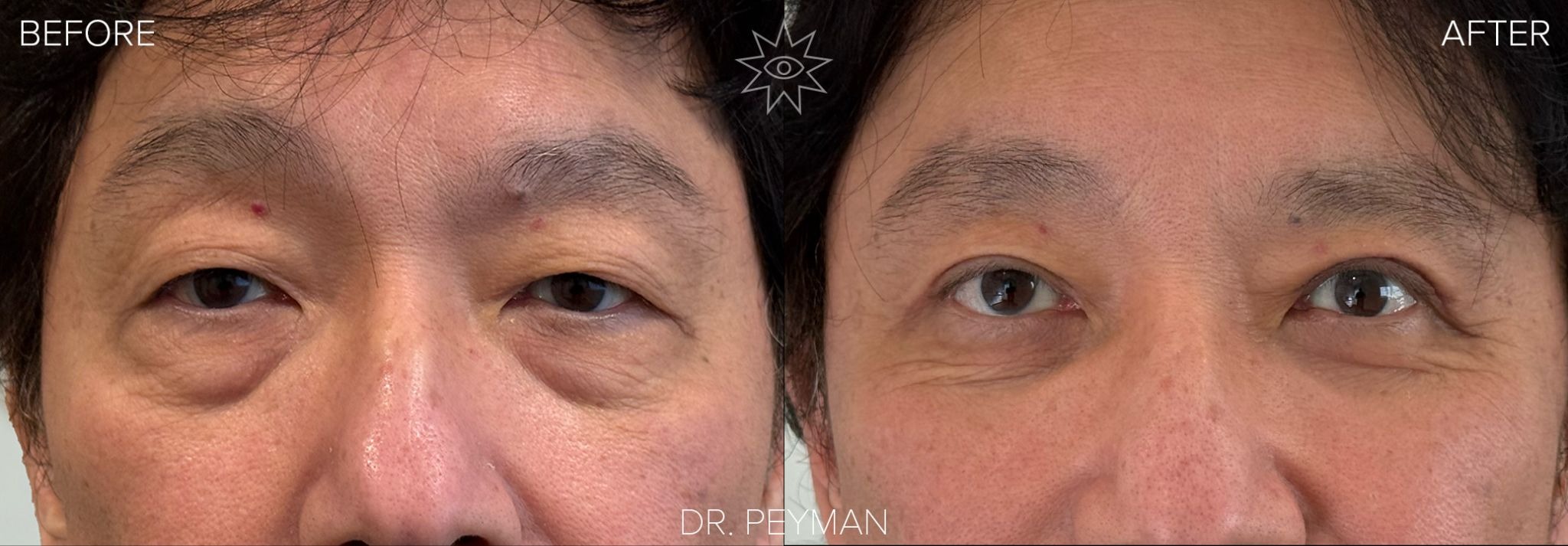
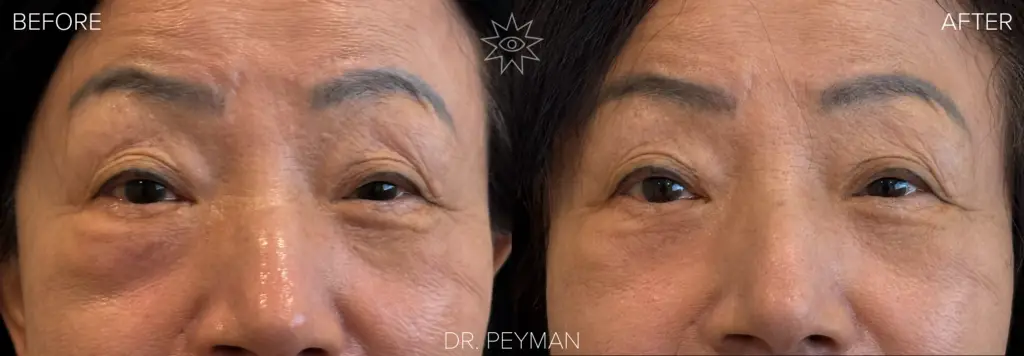
Looking at the before image, the fullness under her right lower eyelid is visible. It sits in a location and with a contour that could easily be mistaken for a common under-eye bag, particularly by someone who has had prior lower eyelid surgery and has been accustomed to seeing some fullness in that area.
The after image reflects a more smooth and even contour along the right lower eyelid. The fullness and firmness under the eyelid are gone. And importantly, there is no visible evidence of surgery because none was left behind on the outside.
Don’t be Alarmed
This post is not meant to alarm anyone with under-eye bags. The vast majority of lower eyelid fullness is exactly what it appears to be: herniated orbital fat. It is a structural, genetic, and age-related condition that is common, benign, and very treatable. Most people reading this who have eye bags have nothing more than eye bags. Our intent in posting this blog is to make patients aware of the red flags to look for in cases that may be more than just a typical bag under the eyes.
When to See a Specialist
Dr. Peyman’s message for anyone reading this who has a lump around the lower eyelid that they have been watching or dismissing is straightforward.
If the lump is getting larger over time, that warrants evaluation.
If it feels firm rather than soft and compressible, that warrants evaluation.
If it becomes red, warm, or painful, that warrants evaluation.
A soft, stable fullness that has not changed in years and feels the same whether you are tired or rested is almost certainly a fat bag. But a lump that is growing, a lump that is hard to the touch, or a lump that has changed in any way is something an oculofacial surgeon should look at in person. The consultation is simple and non-invasive. The examination itself can tell a great deal. Imaging may be warranted.
Do not assume that because something is near the eye it must be a bag. And do not assume that because something has been there a long time it is safe to continue ignoring it. This patient had been living with this mass for years. Her ophthalmologist saw it once and knew something was different.
Why Oculofacial Expertise Matters
The orbit and the structures immediately surrounding the eye are among the most anatomically complex areas of the body. The ability to identify an unusual mass, access it through a hidden internal incision and remove it completely without external scarring as an outpatient comes from expertise in the eyelid and orbital space.
Dr. Jason Sabet-Peyman is a board-certified ophthalmologist and fellowship-trained oculofacial plastic surgeon who focuses exclusively on the eyelids and surrounding structures. His background in ophthalmology means he understands the delicate anatomy of the eyelid and deeper orbital structures and can help manage complex eyelid/orbital issues.
Schedule a Consultation in Fullerton, CA
If you have a lump near your lower eyelid that is growing, feels firm, or has changed in any way, a consultation with Dr. Peyman is the right first step. He serves patients across Orange County including Fullerton, Anaheim, Brea, Yorba Linda, Newport Beach, Irvine, Laguna Beach, and Huntington Beach.
Call our Fullerton office at 714-449-1940 to schedule your consultation.