The one thing that holds more people back from eyelid surgery; more than the cost, having the procedure itself, or fear of complications; is fear of the recovery process. How long will I look swollen? When can I go back to work? Will people be able to tell?
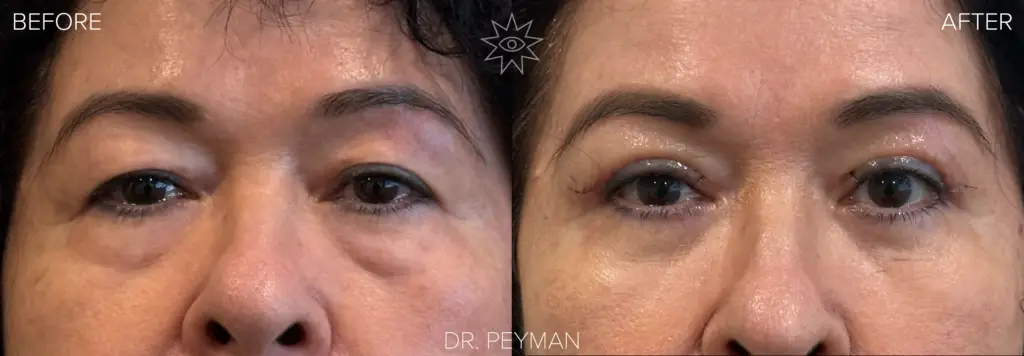
These are completely understandable questions, and we believe in answering them honestly and transparently. So today we are sharing something a little different. A real before and after photo taken just ten days after a combined upper and lower blepharoplasty at our Fullerton office.
The results you are looking at are not from six weeks out. Not from three months out. This is ten days.
A Quick Note Before We Begin
Every patient heals differently. Factors like how closely patients follow the postoperative instructions, age, skin type, overall health, lifestyle habits, and individual anatomy all play a role in how quickly and smoothly recovery progresses. This patient healed exceptionally well and her ten-day results are genuinely impressive even by our standards.
We are sharing these photos not to set a universal expectation but to show you what is possible, and to reassure you that for many patients the recovery is far more manageable than they feared going in. Your experience may look different from hers, and Dr. Peyman will give you a realistic and personalized picture of what to expect during your consultation.
What Was Treated: Combined Upper and Lower Blepharoplasty
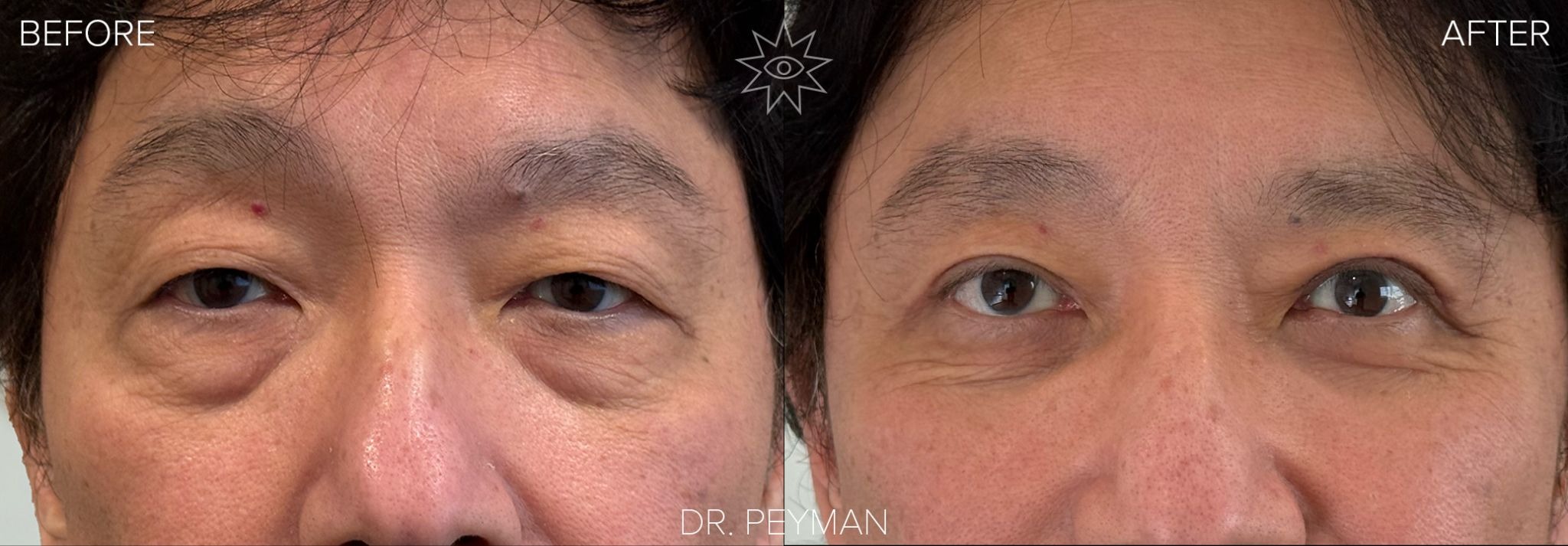
This patient came to our Fullerton office with two distinct but related concerns. Her upper eyelids had developed redundancy that was creating heaviness and hooding over the eyes. Her lower eyelids showed prominent fat herniation beneath both eyes, creating the classic tired and puffy under-eye appearance that no amount of sleep or skincare could address.
Dr. Peyman performed a combined upper and lower blepharoplasty, sometimes called a Quad Bleph, addressing both areas in a single procedure under local anesthesia. Combining both procedures meant she only needed to go through one recovery period rather than two, and it allowed Dr. Peyman to restore balance and harmony to the entire eye area at once.
The Before: What She Was Dealing With
Looking at her before photo, both the upper and lower eyelid concerns are clearly visible. The upper eyelids show the characteristic hooding of dermatochalasis, where excess skin drapes downward over the natural eyelid crease. Beneath both eyes, prominent fat bags cast a heavy shadow that made her entire eye area look tired and aged regardless of how rested she actually felt.
This is a very common combination of concerns that Dr. Peyman sees regularly in patients from across Orange County, and it is one where the combined approach consistently delivers the most natural and balanced result.
The After: Just Ten Days Later
Looking at her ten-day post-operative photo, the transformation is already remarkable. The lower eyelid fat bags that were creating puffiness and shadowing beneath both eyes are dramatically reduced. Her upper eyelids are visibly lighter and more open. Her entire eye area looks refreshed, brighter, and significantly more rested.
There is still some mild residual swelling present, which is completely normal and expected at this stage of recovery. Swelling after eyelid surgery typically continues to improve gradually over the following weeks, meaning her final result will look even more refined than what you see here at the ten-day mark.
What is most impressive is not just how much improvement is already visible but how natural and normal she looks for someone who had surgery less than two weeks ago. For many patients the concern is that they will look obviously surgical or heavily swollen during recovery. Her photos tell a very different story.
What a Typical Upper and Lower Blepharoplasty Recovery Looks Like
While every patient is different, here is a general timeline of what most patients can expect after a combined upper and lower blepharoplasty with Dr. Peyman.
Days 1 to 3
The first couple of days are typically the most bruised and swollen. Cold compresses and keeping the head elevated help significantly with the bruising and swelling. In the vast majority of cases, patients are pain free when Dr. Peyman calls them the night of the procedure. Patients may take some tylenol in the first few hours after the procedure if needed. Most patients are resting comfortably at home and are surprised by how little pain they actually experience.
Days 4 to 7
Swelling and bruising begin to visibly improve. Many patients feel comfortable enough to drive, do deskwork, and go for walks with sunglasses and/or hats.
Days 7 to 14
This is where many patients, like our patient featured here, start to feel and look significantly better. Bruising has faded considerably for most patients and residual swelling continues to improve. Many patients return to desk-based work and light daily activities during this window. Sutures are generally removed days 7-10.
Weeks 3 to 6
The majority of visible swelling has resolved for most patients and the results become much more clearly defined. Most patients feel completely comfortable in social and professional settings without any obvious signs of recent surgery.
Months 2 to 3
Final results are typically fully visible by this stage. The eyes look their most refined and natural, and any residual subtle swelling from the deeper tissues has completely resolved.
Why Some Patients Heal Faster Than Others
Recovery timelines vary from person to person for a number of reasons, and understanding this can help set realistic expectations going into surgery.
Overall health and lifestyle play a significant role. Patients who are in good general health, do not smoke, stay well-hydrated, and follow post-operative instructions carefully tend to heal more quickly and with less bruising and swelling.
Age and skin quality also matter. Younger patients with better skin elasticity often heal more visibly quickly, though excellent results are absolutely achievable at any age.
Following post-operative care instructions is one of the most important factors entirely within the patient’s control. Keeping the head elevated, avoiding strenuous activity, applying cold compresses for the first 3 days, and protecting the healing area from sun exposure all contribute meaningfully to a smoother and faster recovery.
Individual anatomy and healing response are simply different from person to person. Some patients naturally bruise more than others or retain fluid differently. This is not a reflection of surgical quality or outcome, it is simply how individual bodies respond.
Is This You?
If you have been putting off eyelid surgery because the recovery felt too intimidating, we hope these photos give you a more realistic and encouraging picture of what the experience can actually look like. Not everyone will have a ten-day recovery this smooth, but many patients are genuinely surprised by how much easier the process is than they anticipated.
If heavy upper eyelids, under eye bags, or both are affecting how you look and feel every day, a consultation with Dr. Peyman is the best first step. During that visit he will evaluate your specific anatomy, discuss your goals, and give you a personalized and honest picture of what your recovery and results may look like.
FAQ: Upper and Lower Blepharoplasty Recovery
How long does it take to recover from upper and lower eyelid surgery?
Most patients feel comfortable returning to light daily activities within one to two weeks. Combining upper and lower procedures does not significantly extend recovery compared to having just one area treated. Most visible swelling and bruising resolves within two to three weeks, with final results fully visible by two to three months.
Will I look swollen after eyelid surgery?
Some degree of swelling and bruising is normal and expected after any eyelid surgery. The amount varies from patient to patient. As the photos in this post show, many patients look and feel much better than expected within the first ten days.
When can I go back to work after blepharoplasty?
Most patients with sedentary or desk-based jobs return to work within seven days. Patients with more physically active jobs may need a little more time. Dr. Peyman will give you a personalized recommendation based on your specific procedure and lifestyle.
Can I wear makeup during recovery?
This depends on the type and approach of the procedure. Dr. Peyman will give you specific guidance during your follow-up appointments. A good bet is by 2 weeks out.
Will people be able to tell I had surgery during recovery?
The level of visible bruising and swelling varies significantly between patients. Many patients are comfortable going out in public with sunglasses within the first week. By the two-week mark many patients, like the one featured here, look refreshed and natural rather than obviously post-surgical.
Does combining upper and lower blepharoplasty make recovery harder?
Not significantly. Most patients find that combining both procedures into one recovery period is more convenient than having two separate procedures and two separate recovery windows. The overall recovery timeline is similar to having just one procedure done.
How much does combined upper and lower blepharoplasty cost in Orange County?
Pricing is determined on a case-by-case basis depending on your specific anatomy and goals. A quote for your particular case will be provided at your consult.
How do I get started?
Call our Fullerton office at 714-449-1940 and set up your appointment with Dr. Peyman today.
Schedule Your Consultation in Fullerton, CA
If you have been hesitant about eyelid surgery because of recovery concerns, we hope this patient’s real ten-day results have given you a more honest and encouraging picture. Dr. Peyman serves patients from across Orange County including Fullerton, Newport Beach, Irvine, Yorba Linda, Laguna Beach, and surrounding communities.
Call our Fullerton office today at 714-449-1940 to schedule your consultation.
Dr. Jason Sabet-Peyman is a board-certified ophthalmologist and fellowship trained oculoplastic specialist with over 10 years of experience specializing exclusively in plastic and reconstructive surgery of the eyelids and surrounding facial structures. His practice is located in Fullerton, CA and serves patients throughout Orange County.