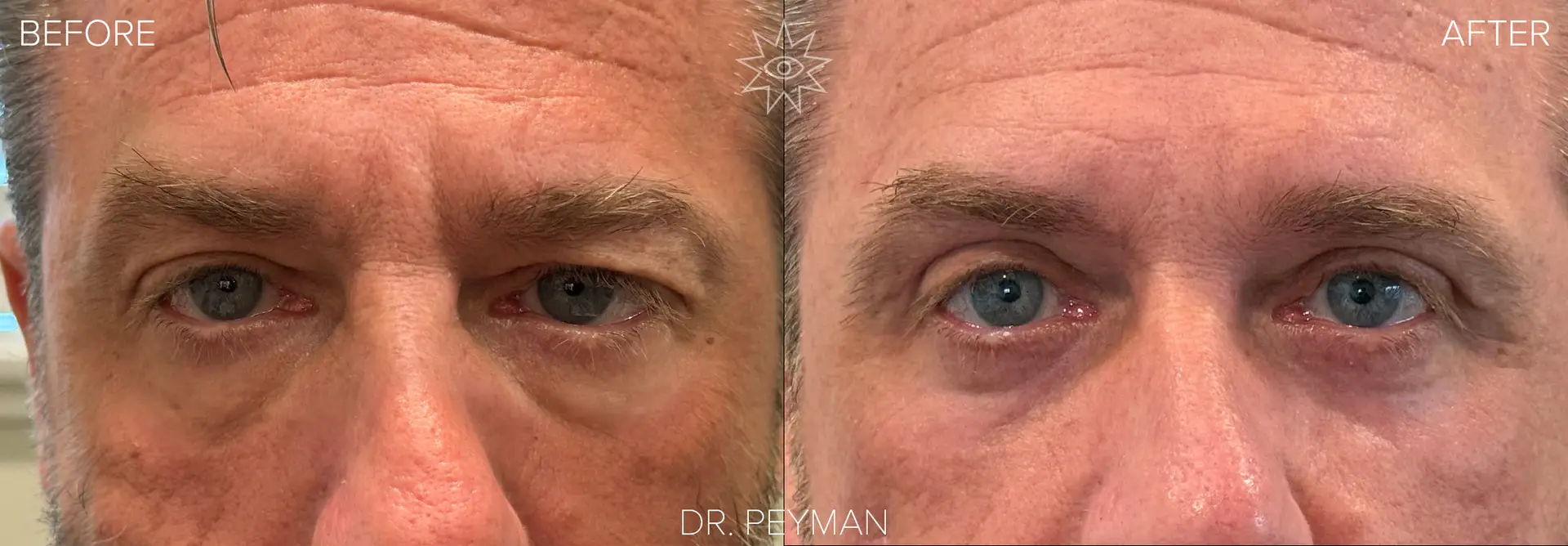
She came in unsure.
Not unsure whether she wanted something done about her eyelids. She had wanted that for years. She was unsure whether she qualified. Whether her situation was bad enough, or the right kind of problem, or something that surgery could actually fix.
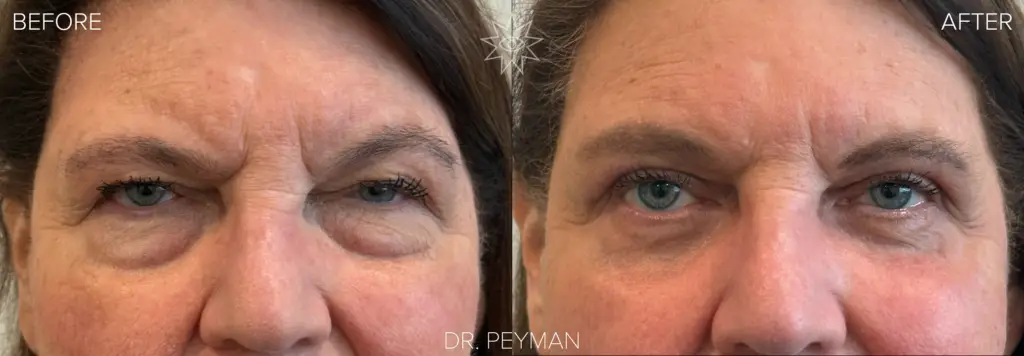
The answer, once she sat down with Dr. Peyman and heard what he saw when he looked at her eyes, was yes. A clear, confident yes. And the before-and-after photos you see here tell the rest of that story.
But her hesitation is one of the most common things we encounter in consultations. Patients research eyelid surgery for months, sometimes years, and still arrive not knowing if they should have the surgery. This post is for anyone sitting with that same quiet uncertainty.
Here is what actually determines whether you are a good candidate for eyelid surgery, and why the answer may be different from what you expect.
Her Presentation
Looking at her before photo, two things are immediately visible.
Her upper eyelids carry significant excess skin that has drooped down over the natural eyelid crease, creating a heavy, hooded appearance that partially shadows her eyes particularly on her left side making her look angry. Her lower eyelids show prominent puffiness from herniated fat pads that create persistent under-eye bags, giving her a tired appearance that no amount of sleep or concealer could fully address.
She was also doing something many patients with heavy upper lids do without realizing it: subtly raising her brows to compensate for the weight on her lids. That chronic effort shows as furrow lines and a slightly strained quality to her expression.
She came in thinking she might only need her upper lids addressed. Dr. Peyman evaluated the full picture and recommended a quad blepharoplasty, all four eyelids in one procedure, to create a balanced, natural result.
The after photo shows what that decision produced: open, defined upper lids with the natural crease fully visible, smooth lower lids without the puffiness, a relaxed brow, and an expression that reads as alert and genuinely rested. She looks like herself. A lighter, more open, less angry, and more refreshed version of herself.
The Question Most Patients Are Really Asking
When patients say “am I a good candidate?”, what they are usually asking is one of three different things:
“Is my problem bad enough to warrant surgery?”
This is more common than you might think. Many patients have lived with their eyelids for so long that they have normalized what they see in the mirror. They wonder whether their concern is significant enough to bring to a surgeon, or whether they will be told to come back in ten years.
There is no minimum severity required to explore your options. If your upper or lower eyelids are affecting how you look, how you feel when you look in the mirror, or how others perceive your expression, those are valid reasons to have a conversation.
“Is something about my situation too complicated?”
Some patients worry that their eye health history, their medications, their age, or the specific nature of their eyelid concerns will disqualify them. This is where a proper evaluation by a fellowship-trained oculoplastic surgeon makes all the difference.The answer depends on your specific anatomy, prior eyelid surgery history, health, and goals, and Dr. Peyman needs to evaluate carefully prior to answering the question during your consultation.
“Will the result look natural on me?”
This is a fear, not a candidacy question, but it often gets folded into the same worry. Patients who have seen overdone or unnatural results elsewhere are afraid that eyelid surgery will change who they are or make them look like someone else. A well-planned, conservatively executed blepharoplasty does not change you. It restores you. Her after photo is the answer to that fear.
What Actually Makes Someone a Good Candidate
Here is what Dr. Peyman evaluates at every consultation when determining whether eyelid surgery is appropriate:
Upper eyelid concerns:
Excess skin resting on the lashes or covering the natural eyelid crease, upper eyelid heaviness that feels physically tiring by the end of the day, or hooding that makes the eye appear smaller or more closed than it should. For some patients, it may not be the skin but the drooping of the eyelid platform requiring muscle advancement. Others may have fat herniation along the inner eyelid area. Others may have asymmetries that need to be addressed. The discussion and procedure(s) need to be customized to each individual patient.
Lower eyelid concerns:
Persistent under-eye puffiness from herniated fat pads that does not improve with rest, hollowing or shadows under the eyes that make you look older or more fatigued than you feel, or loose skin beneath the lids that has become more noticeable with time. Some patients may have laxity of the lower eyelid margin that needs to be addressed. The specific procedure(s) need to be customized to the patient.
Overall health:
Good general health is important for any surgical procedure. Every patient has a physical with their primary care doctor prior to surgery. A thorough review of medical history, current medications, and any eye conditions is part of every pre-operative evaluation. This ensures safe outcomes during surgery.
Realistic goals:
The best candidates for eyelid surgery are people who want to look more rested, refreshed, and like a better version of themselves. Not dramatically different. Just refreshed, lighter, and more open around the eyes. Depending on their presentation, some patients, as the patient shown, will have a more dramatic before and after than others with less prominent hooding or bags under their eyes.
Eye surface health:
Because eyelid surgery affects the structures surrounding the eye, Dr. Peyman evaluates the health of the eye surface and tear film as part of every consultation. Patients with certain dry eye conditions may need additional evaluation or modified approaches, but this rarely means surgery is not possible.
Why Both Upper and Lower Lids Often Need to Be Addressed Together
This patient’s case is a perfect illustration of something Dr. Peyman sees frequently. Patients come in focused on one area and are surprised to learn that addressing both upper and lower lids together produces a far more natural and complete result.
When only the upper lids are treated, the under-eye bags can appear more prominent by comparison. When only the lower lids are treated, the heavy upper skin still crowds and ages the eye. Together, the result is harmonious. The entire eye area reads as open and refreshed rather than half-corrected.
Combining both procedures also means one recovery period instead of two. One time off from work. One set of post-operative instructions. One healing window.
For patients who need both, doing them together is almost always the more sensible and satisfying approach.
What the Consultation Actually Looks Like
You will have the chance to point to exactly what bothers you. Dr. Peyman will examine your eyelid anatomy carefully, look at the position and function of the eyelid muscles, assess your skin quality, evaluate your lower lid fat distribution, and explain clearly what he sees and what can be done. You will leave knowing whether you are a candidate, what the procedure would involve, what recovery looks like, and what kind of result is realistic for your specific anatomy.
There is no pressure. No commitment. Just information.
This patient walked in with a question and walked out with a plan. Her after photo is what that plan produced.
You Do Not Need to Be Certain Before You Come In
One of the most important things to understand about candidacy for eyelid surgery is this: you do not need to already know you are a candidate before you schedule a consultation. That is what the consultation is for.
Patients who wait until they are completely sure often wait years longer than necessary. The questions you have, including whether you qualify, whether it is safe, whether it will look natural, whether it is worth it, are exactly the questions a consultation is designed to answer.
If you have been looking at your eyelids and wondering whether something can be done, the first step is simply coming in to find out.
Eyelid Surgery Consultations in Fullerton and Orange County
Dr. Jason Sabet-Peyman is a fellowship-trained oculofacial plastic surgeon based in Fullerton, California. He specializes exclusively in eyelid and periocular surgery, including upper blepharoplasty, lower blepharoplasty, quad blepharoplasty, ptosis repair, and laser resurfacing. He serves patients throughout Fullerton, Anaheim, Brea, Yorba Linda, Placentia, Orange, Newport Beach, and surrounding communities across Orange County.
If you have been sitting with the question this patient came in with, this is your invitation to come find out the answer.
Call our Fullerton office at 714-449-1940 to schedule your consultation.